Rethinking the Test: How One Maths Faculty Is Changing What Assessment Means
Walk into Dean Carlton's mathematics classroom at St Michael's Grammar School on almost any given day, and you are unlikely to hear the phrase 'right or wrong.' What you are more likely to hear is a question: 'What do you know now that you didn't know before?'
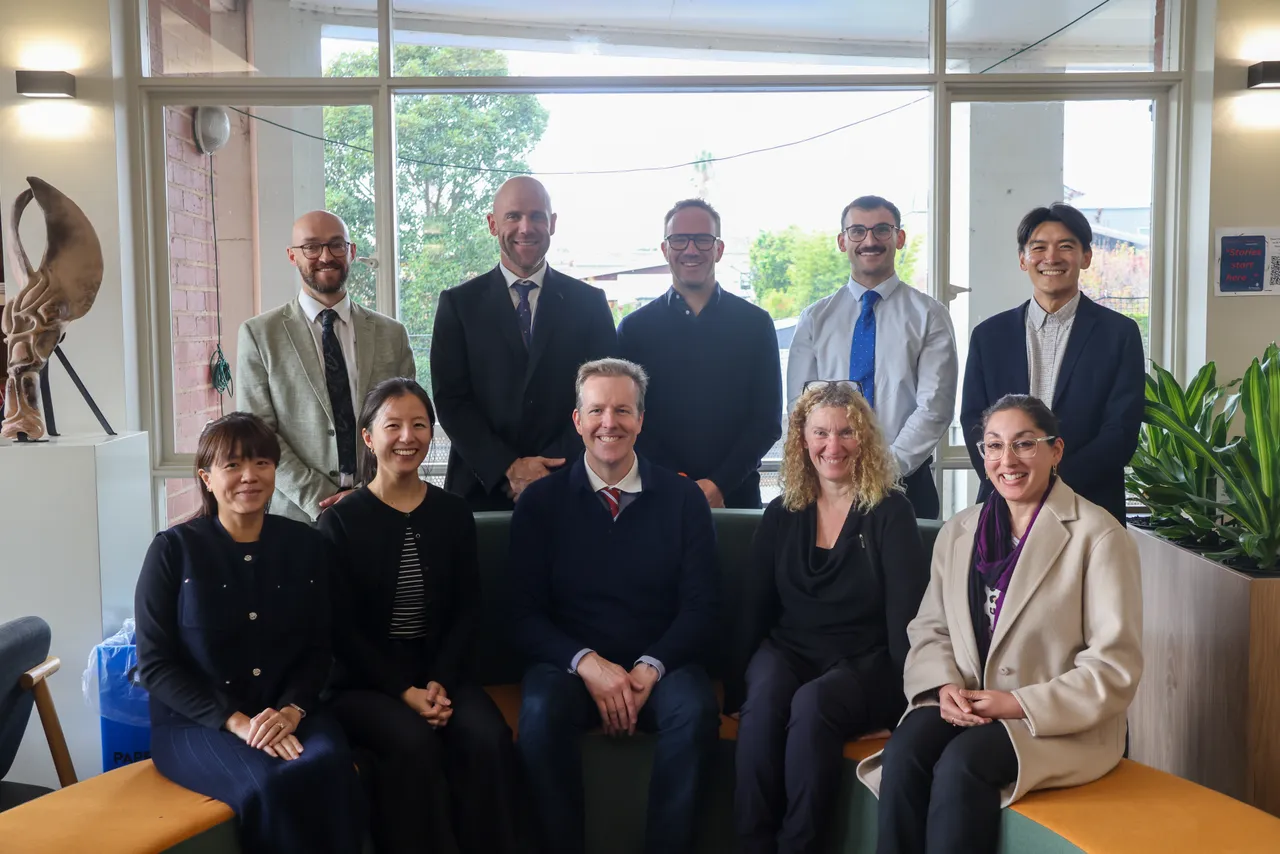
That shift - from verdict to inquiry - is at the heart of a significant evolution in the way St Michael's Senior School mathematics faculty approaches assessment. Over the past several years, Dean Carlton , alongside Head of Mathematics Thomas Allott and Assistant Head of the Maths Faculty Anthony Liu, have been building a model that treats testing not as the end of a learning sequence, but as a starting point for it.
A Different Starting Point
Dean has spent seventeen years teaching mathematics at St Michael's, and much of that time has been shaped by a single observation: the students who struggle most in mathematics are rarely those who lack ability. They are, far more often, those who have come to believe they lack ability — and that belief has been reinforced, year after year, by the way assessment works.
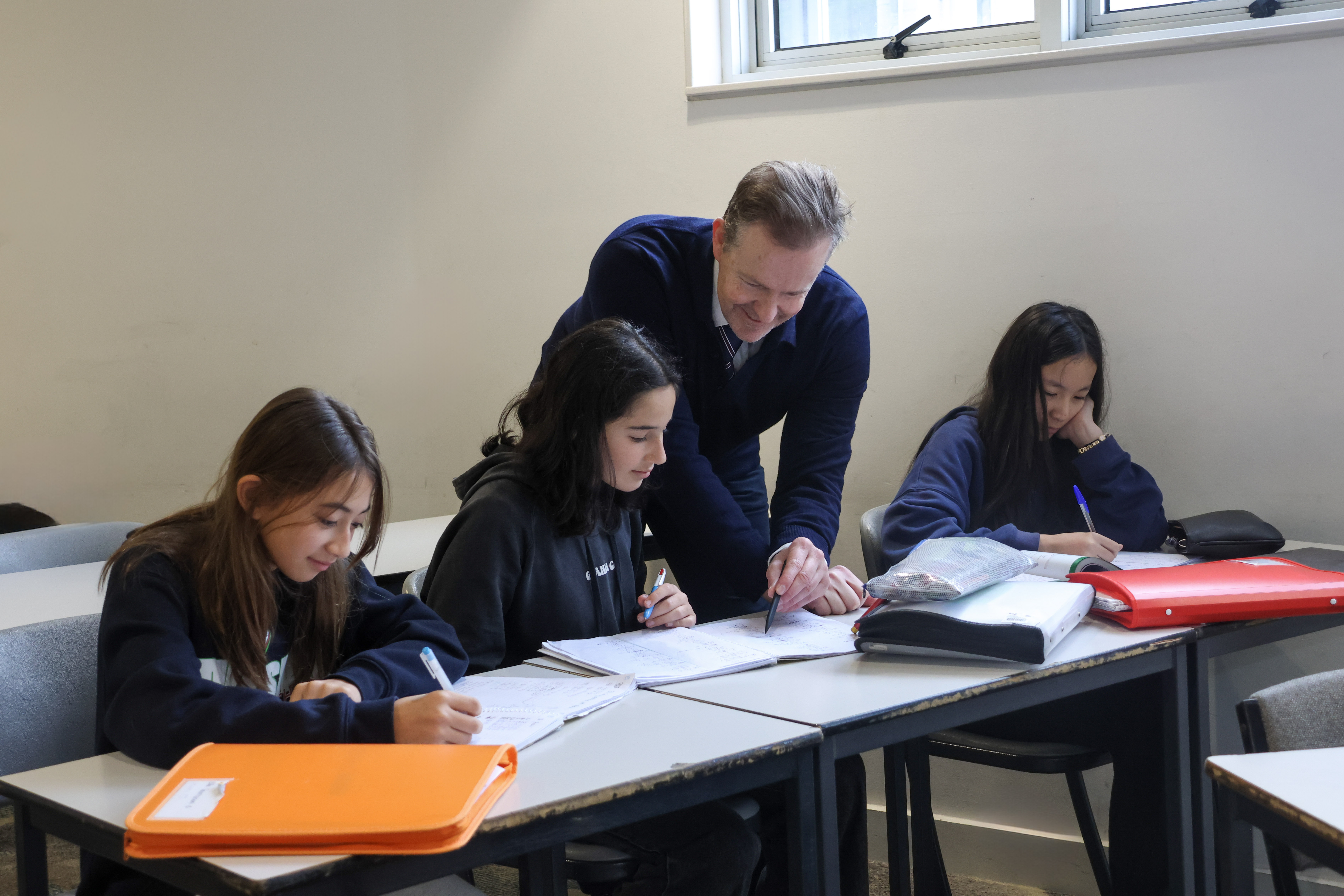
'Students arrive in Year 7 already carrying a verdict about themselves,' Dean explains. ''I'm dumb at maths'' is not an uncommon thing to hear. That identity was built somewhere — through years of tests that functioned as judgements rather than as tools for learning.'
The conventional mathematics test, Dean argues, carries a hidden message: what you score today is who you are in this subject. For students who already feel uncertain about their mathematical ability, that message can be devastating — and lasting.
"The way we assess mathematics shapes the way students feel about mathematics. And the way students feel shapes everything else."
Review as the Main Event
The model the Maths team have developed turns that logic on its head. At St Michael's, the initial test is treated as a diagnostic — a signal about where students currently are and where they need to go. The review process that follows is weighted more heavily in assessment than the test itself.
In practice, this means students who perform poorly on an initial assessment are not simply handed a score and moved on to the next topic. They identify their gaps, engage with the mathematics, and demonstrate their understanding in a structured reassessment. The weighting makes the faculty's priorities explicit: what matters is not performance under pressure on a given day, but the sustained work of understanding.
'I tell students the emotion that comes with a low score is valid,' Dean says. 'Feel it. Then act. Go back, work through it, and experience what it feels like when something clicks. That cycle — trying, struggling, understanding, feeling the reward — is how the brain builds a new relationship with mathematics.'
From Marks to Competencies: The Shift to Rubrics
Alongside this review-weighted approach, the faculty has moved to rubric-based assessment — a structural change that Dean describes as one of the more significant shifts in his teaching career.
In a subject where marking has traditionally been binary — right or wrong, method present or absent — rubrics introduce a different kind of conversation. They describe what a student can do, rather than simply recording what they got correct. They make visible the qualities of mathematical thinking that a score alone cannot capture: reasoning, persistence, the ability to self-monitor and identify what remains unknown.
The rubric’s design draws on the New Metrics program at the University of Melbourne, which measures key competencies rather than content recall. The intention is to align St Michael's assessment with a broader understanding of what mathematical capability actually looks like — and to give students a language for their own learning that extends well beyond the exam room.
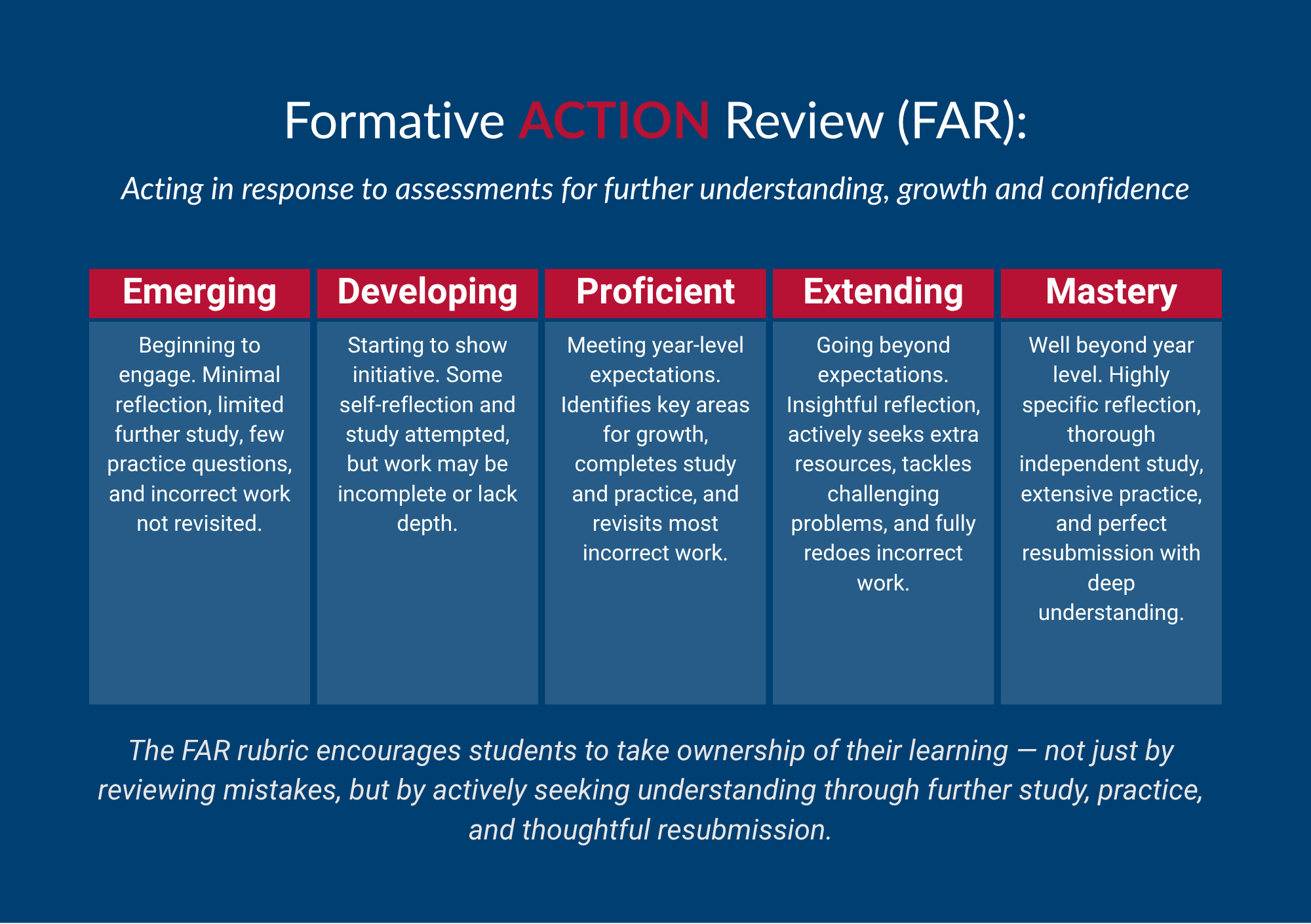
"For a maths faculty to go rubric-based is different. It asks teachers to describe what good mathematical thinking looks like — and that is a harder, more important question than marking an answer correct."
Changing the Internal Dialogue
The impact Maths Faculty has observed goes beyond academic performance. Students who understand that assessment is a tool for learning — not a final judgement — engage with it differently. The paralysing anxiety that high-stakes testing can provoke, particularly in students who already feel fragile about their mathematical identity, begins to ease when there is always a next step.
Dean is deliberate about making this explicit. He teaches students that struggling is part of the process, that emotion is a legitimate companion to learning, and that the measure of a good mathematician is not whether they know something immediately — it is whether they have the confidence to try something they do not yet know.
Over time, the faculty observes what Dean describes as a rewiring: students whose internal narrative about mathematics shifts, gradually but meaningfully, from fixed identity to growth. 'I'm not a maths person' gives way, slowly, to something closer to ‘I’m confident to learn about my weaker areas.’
Building Something That Lasts
Dean is clear that this work is not a personal project — it is a faculty endeavour, and its ambition is institutional. The rubrics, review processes, and weighting structures being developed at St Michael's are designed to be embedded in the school's practice rather than dependent on any individual champion.
He is completing a fellowship with the Victorian Academy of Teaching and Leadership in 2026, focusing on navigating mathematics anxiety and systematic reassessment — professional learning that has both informed and accelerated the faculty's work. The fellowship connects the school's classroom practice to a broader state-wide conversation about what mathematics education can and should look like.
For Dean, the question driving all of it is straightforward. 'What is assessment actually for?' If the answer is learning — genuinely, sustainably, for every student — then the red pen, and the verdict it delivers, may need to make room for something more. Because when assessment works, students don't just receive a judgment. They leave knowing what to do next — and believing they're the ones who can do it.
St Michael’s is one of Australia’s leading independent coeducational schools, educating more than 1200 students from Kindergarten to VCE. We acknowledge the Boonwurrung People of the Kulin Nation as the Traditional Custodians of the land on which St Michael’s stands. We pay respect to their ancestors, elders and emerging leaders, and we are committed to reconciliation through authentic relationships and continued cultural learning.
site by Digistorm, a Veracross solution
© 2026 St Michael’s Grammar School