More Than Memorisation: Why Getting Junior School Maths Right Changes Everything
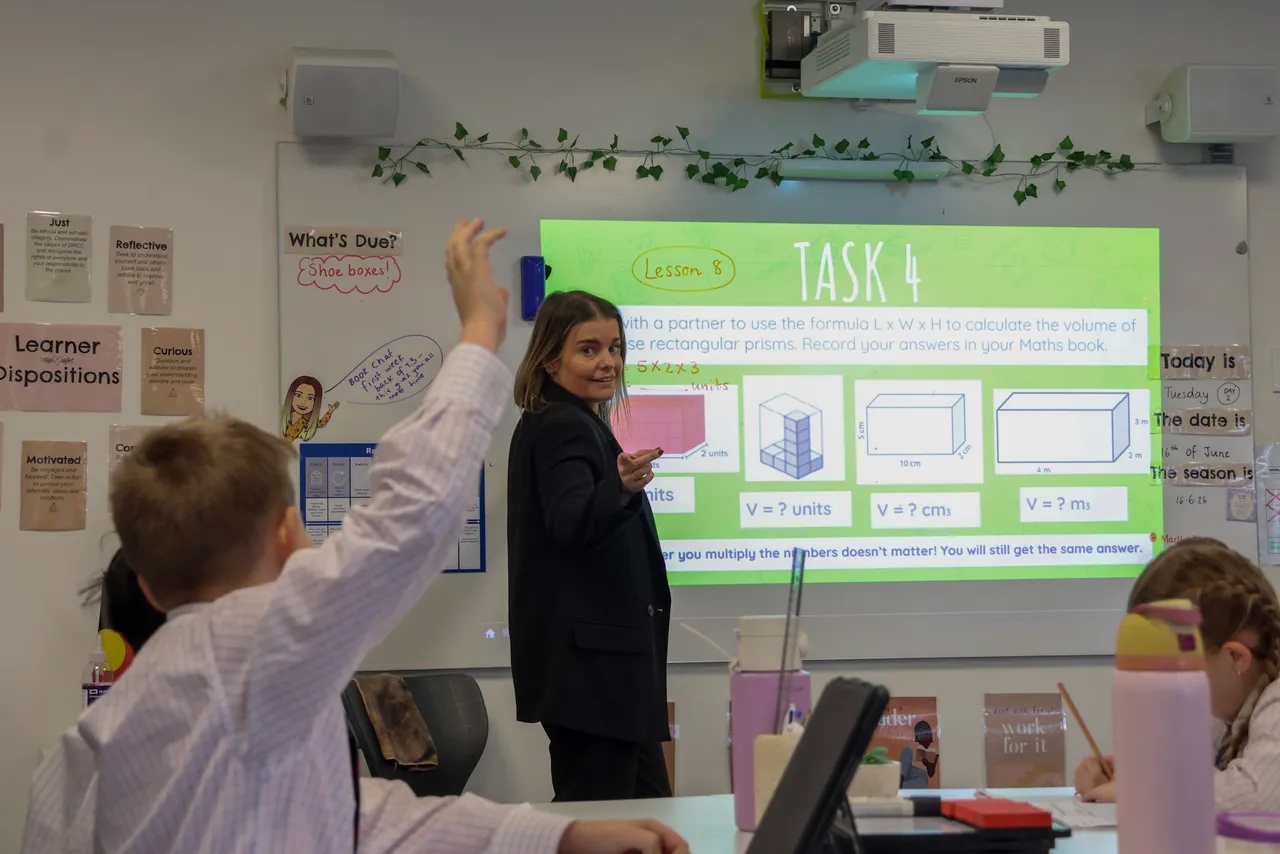
We sat down with Junior School Teacher Sinead Corduff to talk about growth mindsets, the power of the “aha” moment, and why what happens in primary school Maths matters far more than most people think.
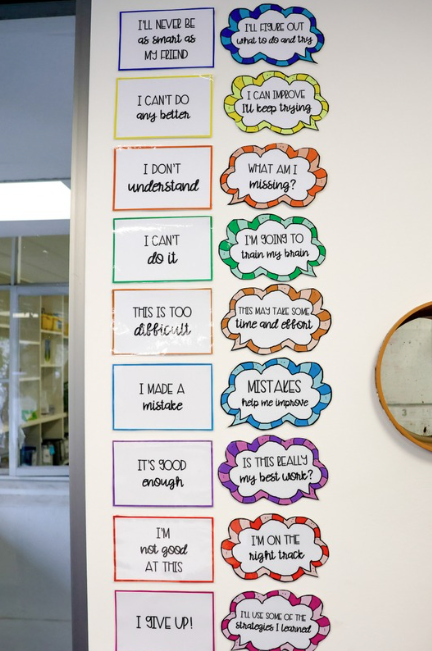
Walk into Sinead’s Year Five classroom at St Michael’s Grammar School on most mornings, and you will find something on the wall that does not look like a maths lesson. Fixed mindset phrases — I can’t do this, I give up, I’m just not a maths person — sit alongside their growth mindset counterparts, quietly rewritten into something more useful. The wall is not decoration. It is instruction.
Because for Sinead, how a child talks to themselves about Mathematics is as important as any strategy or algorithm she teaches. And by the time children reach the upper years of primary school, many have already started writing a story about themselves and Maths, a story shaped by years of small moments in the classroom that, if left unchallenged, tends to get harder to rewrite.
A Different Kind of Starting Point
Sinead came to St Michael’s after sixteen years in Catholic primary education, drawn by something specific. At her previous school, she had watched a gradual shift in teaching philosophy: a steady narrowing toward explicit instruction at the expense of inquiry-based learning. ‘There’s absolutely a place for explicit instruction,’ she says. ‘But I felt like something was getting lost. The opportunity for children to wrestle with a problem, to develop their own strategies, to learn from each other — that space was shrinking.’
What she found at St Michael’s was balance. A school willing to hold both approaches together, moving fluidly between explicit teaching and open problem solving depending on what the lesson and the child actually needed.
That balance runs counter to a misconception she encounters regularly: the idea that a classroom is either structured or exploratory, that a teacher must choose between the two. Sinead is unconvinced. ‘You should be able to blend them,’ she says. ‘Children need to be explicitly taught certain strategies — especially in Maths — but they also need the chance to solve problems for themselves and learn from making mistakes.’
Safe to Get It Wrong
The structure in Sinead’s classroom is real and deliberate. There are routines, consistent rhythms, a clear sense of what to expect. But the purpose of that predictability is not control: it is freedom. ‘If students know what’s happening, they’re not using energy questioning the environment,’ she explains. ‘They can put that energy into new learning instead.’
Within that structure, there is room for genuine risk. Students are encouraged to attempt problems they are not certain about, to share answers they are not sure of, to sit with uncertainty long enough to move through it.
That work starts early. At the beginning of Year Five, Sinead’s class spends significant time on Maths mindsets, treating it not as a side programme but as foundational to everything that follows. Students learn what actually happens in the brain when they tell themselves they cannot do something. ‘There’s science behind it,’ she says. ‘Synapses literally shut off when you say you can’t. But if you stay open, if you’re willing to make mistakes, you grow.’
“If everything is easy and you’re comfortable, you’re not actually learning. That’s the message we work hard to build.”
The fixed and growth mindset phrases on the wall are not motivational posters: they are tools. Children learn to catch their own internal narrative and reframe it. It is, in the best sense, metacognition made visible.
A Subject She Had to Learn to Love
Sinead’s relationship with Mathematics was not always straightforward. As a child, she found it frightening, a sequence of steps to follow without ever quite understanding why they worked. ‘It was all algorithms,’ she recalls. ‘Carry this, do that. I could follow the process, but I didn’t understand what I was actually doing.’
It was only when she began learning how to teach Mathematics, encountering strategies and ways of thinking she had never been shown as a student, that the subject opened up for her. Understanding replaced procedure, and with it came something close to affection for the discipline.
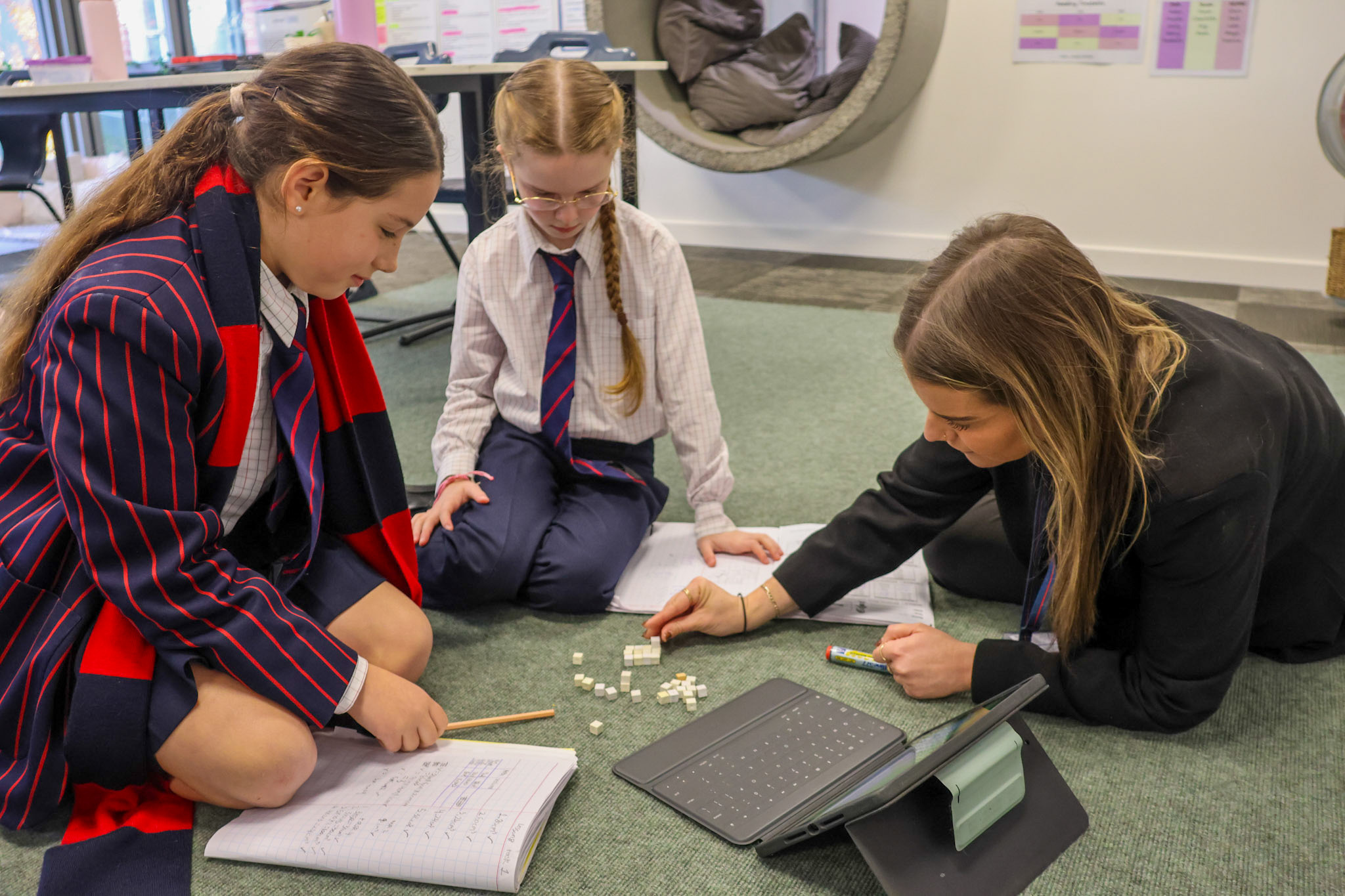
‘The more I started teaching, the more passionate I became. Because once you understand it, Maths actually makes sense. There’s a right and a wrong. There’s a clarity to it,’ she says. ‘And when you see a child get that — that “oh” moment — that’s everything. That’s where the passion comes from.’
Building Number Sense, Not Just Number Skills
One of the most significant shifts in how Maths is taught today, and one that often surprises parents, is the move away from written column arithmetic as the default first tool. In the past, children were typically taught to solve even simple additions by stacking numbers in columns and working through them digit by digit: a process known as the vertical or column method. For a problem like 23 plus 22, that means writing one number above the other, drawing a line underneath, and adding from right to left. It works, but Sinead argues that reaching for it too quickly can short-change a child’s understanding.
What she prioritises instead are mental strategies: approaches that encourage children to think about what numbers actually mean before they write anything down. For that same 23 plus 22, a child might simply recognise that two tens and two tens make forty, and three ones and two ones make five, arriving at 45 without ever picking up a pencil. The vertical method is not abandoned; it remains genuinely useful for larger, more complex calculations. But it is taught as one tool among many, not the automatic first resort.
‘If we rush to the vertical method for everything, we miss the chance to build real number sense,’ she says. ‘Children need to understand what they are doing, not just how to do it.’
Concrete, hands-on materials remain part of the classroom even in upper primary, which sometimes surprises people who assume they belong only to the early years. For Sinead, they are essential longer than most recognise. ‘The more children can engage with something concrete, the better they develop abstract thinking. If we take those materials away too soon, we take away the scaffolding before the building is ready.’
She is equally clear about the role of parents, noting that the gap between how today’s students are taught and how their parents learned Maths can create confusion at home. Helping families understand current strategies rather than defaulting to the methods they remember is part of the job.
“The way Maths feels at Primary school shapes how it feels for years afterwards. If children leave Junior School curious and confident, we’ve done something that matters.”
What She Wants Children to Take With Them
Ask Sinead what she wants her students to feel by the time they leave Junior School, and she is unambiguous. Not just competent. Not just capable of following a method. Excited. Convinced that Maths belongs in their lives and not just in classrooms.
‘The second a child switches off — thinks “I hate Maths” or “I’m just not a Maths person” — it gets so much harder when they reach Senior School,’ she says. ‘But if they leave here still enjoying it, still curious, still believing they can figure things out — that’s the foundation that holds.’
It is a long game, played in the daily rhythms of a primary classroom: in the routines, the wall displays, the problems that are slightly too hard, and the moment unremarkable to anyone else in the room when something finally clicks.
St Michael’s is one of Australia’s leading independent coeducational schools, educating more than 1200 students from Kindergarten to VCE. We acknowledge the Boonwurrung People of the Kulin Nation as the Traditional Custodians of the land on which St Michael’s stands. We pay respect to their ancestors, elders and emerging leaders, and we are committed to reconciliation through authentic relationships and continued cultural learning.
site by Digistorm, a Veracross solution
© 2026 St Michael’s Grammar School