Beyond the Classroom: The Pedagogy Behind Our French Exchange
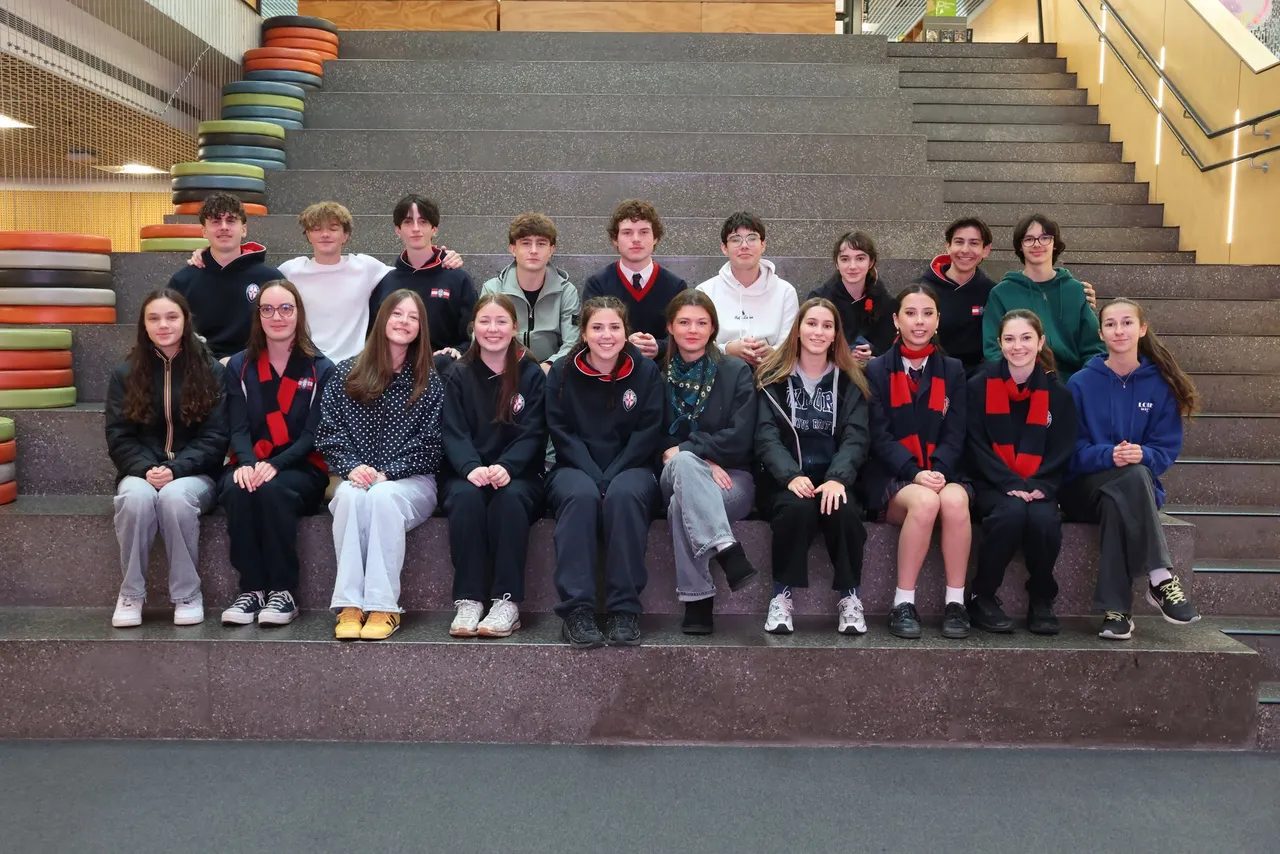
A group of St Michael's Years 10 and 11 students of French are seeing their language studies come to life. They are part of the revival of our French-Australian student exchange program, the first re-iteration since 2020. To make it happen, St Michael's has partnered with a new French school, Lycée Le Grand Lebrun in Bordeaux.
Nine SMGS students are hosting their French correspondent until the end of July. They will then spend their summer holidays in wintery Bordeaux. It's easy — and true, of course — to talk about a student exchange in terms of adventure. But according to Head of Languages Isabelle Mangeot-Hewison, the real story is in the design of the program itself, and the deliberate thinking that sits behind it.
Why exchange works as pedagogy
Language exchange sits on a simple educational premise: that language is learned by using it, not just studying it. Immersion shifts a student from recalling vocabulary to reaching for it — under real time pressure, in a real context, with a real person waiting on the other side of the sentence. That shift, from rehearsed to lived language, is difficult to replicate in a classroom, however well-resourced. It also asks more of a student than fluency. Living with another family, attending another school and navigating another culture builds the kind of adaptability, independence and empathy that sit alongside academic outcomes on any measure of a well-rounded education — which is precisely why exchange has long been regarded as one of the more effective, if demanding, forms of experiential learning.
Built on relationships, not logistics
The exchange isn't run as a transaction of dates and destinations. It's relationship-driven, built on the school-to-school, teacher-to-teacher and department-to-department connections that keep developing between St Michael's and our partner schools over time. Those relationships are what make the logistics work — and what make the experience trustworthy for families on both sides. Matching individual students and families Rather than a generic group placement, students are matched individually with a partner student in Bordeaux. Over two five-and-a-half-week periods, each pair takes turns hosting the other — first welcoming their partner to Melbourne and St Michael's, then travelling to live as part of their partner's family and attend school in Bordeaux. That reciprocity is deliberate: every student experiences the exchange from both sides, as host and as guest.
Effort in, and an outsized return
It's a program that asks a lot of everyone involved, students, families, staff and our partner school over a sustained 12 weeks. But the return, Isabelle Mangeot-Hewison notes, is disproportionate to that effort: language learning that moves from the page into daily use, and, most importantly, memories and connections that last well beyond the exchange itself. Making the classroom tangible At its core, the program exists to link classroom learning to something real. Grammar and vocabulary become tools for an actual conversation at a dinner table; French history and culture become the streets a student is walking through. For our Senior School language students, the exchange isn't an add-on to their studies — it's where the studies take life.
The French exchange sits alongside SMGS's established Japanese and Italian exchange programs, part of a broader commitment across our Languages faculty to immersive, relationship-based learning
St Michael’s is one of Australia’s leading independent coeducational schools, educating more than 1200 students from Kindergarten to VCE. We acknowledge the Boonwurrung People of the Kulin Nation as the Traditional Custodians of the land on which St Michael’s stands. We pay respect to their ancestors, elders and emerging leaders, and we are committed to reconciliation through authentic relationships and continued cultural learning.
site by Digistorm, a Veracross solution
© 2026 St Michael’s Grammar School